Sep 12

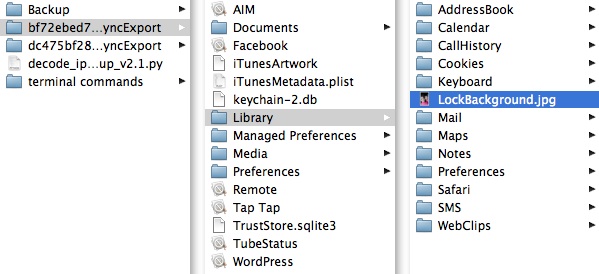
output from python fileIt was bound to happen sooner or later. I took a photo with my phone and used the image as the wallpaper for when the phone is locked. However, I completely overlooked this when I deleted the original image from the camera roll. This meant I had an image in place but no way of accessing it, and I quite liked the image!

It turns out that when you connect your iPhone to your Mac and iTunes starts, it runs a backup and places some files in your ‘~Library/Applications Support/MobileSync/Backup folder. The problem is that they are SQLLite files and not easily readable in any simple way. This is where I turn to the Apple community, particularly the discussions, and ask for help. Here is the post I made.

I was so pleased with the response - almost immediate and ultimately one of the most helpful. It appears there is a Python script able to open those files and restore the folder structure from the innards of your phone. The thread answers the questions most folk will have, but I thought I’d post here too.

What you need to do is copy the backup folder and all it’s contents to an easily accessible place - I chose a new folder on my desktop. Copy the Python script into the same folder. You then need to change the permissions on that script to ensure that it is executable. You should do this through the terminal, which means you’ll probably need to use ’sudo’ and ‘chown’ to set the values correctly. Once you have done this you can run the script. You do this by typing ’sudo’, then the complete path to the script, a forward slash, then the complete path to the folder (you can simply drag the items into the terminal window to do this and the paths will be filled in automatically for you). Finish with a forward slash and then ‘*.mdbackup’.

What this will do is reconstruct the entire iPhone folder structure inside the place you have got the python script and backup folder. Once done you can then set the permissions for the resulting foder and copy to all items inside… you can then access and manipulate the files.

This was, in fact, ludicrously easy - I had help from Alex Blanc who is something of a star with this stuff, but if you know a few basic commands in the terminal you should be OK.

I’ve also uploaded the Python script for you all to download from here in case it goes offline elsewhere. The original is HERE. The one I used (and changed ownership on) is HERE.

Feb 23

50mmf1.8I recently found myself searching eBay for a 50mm prime lens and wandered across a seller with several lots of the Nikkor 50mm f1.8 lens. Having read reasonably positive reviews of this particular piece of glass I decided it was worth a chance, and arranged to meet the seller in Colchester.

This is the stuff of dodgy deals… meet up outside a well known PC shop and hand over cash for a boxed Nikkor lens? One of several available? Well, for £70 it was worth a punt!

Continue reading »

Feb 20

Earlier this month I wrote in fairly scathing terms about the previous version of this software, which to all intents and purposes seemed prematurely released. It was slow, clunky, didn’t run well on a Mac (I understand Windows users were more satisfied) and generally wasn’t worth the money. I couldn’t then review version 2 as it didn’t even install for me, so as you can imagine I was less than positive about it all. Continue reading »

Feb 13

One of the slightly annoying things about Aperture is the limitations placed on you when creating a book. Whilst it is incredibly flexible in lots of ways, certainly much more than iPhoto, there are some things I really want to be able to alter.

One of these is the colour scheme in the ‘Special Occasions’ Aperture Theme. By default, you get a pale blue colour for any panel not holding an image. It looks quite smart, and the ‘helvetica Neue Ultra Light font is smart too… but I often find I want to change it. The trouble is, Aperture doesn’t let you do so easily.

Of course, if you fancy digging around in the files for the app then almost anything is possible! It’s not exactly easy, and you should always make a copy of the theme and work on that rather than jigger around with a perfectly good one and break it, but all you need is an eye for colour (and design?) and a decent text editor. I use BBEdit, but you can do equally well with the free Text Edit that comes with your Mac.

First things first - what I am about to do is not recommended, and I take no responsibility for how your system runs after you try it :-) Seriously though, work on a back up copy of the theme, and you can always delete it later. Also, it is likely that even if you do change things now, any update to the software could well over write your hard work… this tutorial works with v1.5 of Aperture. Apple have only this week released v2 as an update and it boasts new book themes and capabilities. It seems like a good time for me to play with the current version I have got installed, then!
Show contentsYou find the book themes by control-clicking on the aperture application icon (in your Applications folder) and selecting ‘Show Package Contents’ . Navigate to ‘Contents/Resources’ and scroll down to the folder ‘Book Themes’. It’s probably quicker to type ‘book’ as you won’t then have to scroll - the finder will jump to the items with those letters at the start. You’ll then see the themes nicely lined up. Select the one you want to alter and make a copy of it (by holding down ‘Alt’ and dragging the folder to the bottom of the list). You can see that I have copied my ‘Special Occasions’ theme and renamed it ‘Alternate Occasions’. A word of caution - simply renaming the folder won’t give you a new theme name inside Aperture. It *will* list it alphabetically in the theme browser, but the theme list will show two copies of ‘Special Occasion’. We’ll get round to renaming things a bit later on.

Now you have the copy, open the folder and have a look. In my case, the first folder is called ‘Hardcover’ and everything else is in that. The things you may want to change are likely to be the fonts you can use and the colour of the bocks. For the fonts, look for the ‘TextStyles.plist’ file and open it in your text editor. What you’ll see is a series of XML statements which define the fonts in use, the size of them and the colour/style.

Changing Font Colours

TextString

I would leave the ‘Title’ key values alone. these are referenced in lots of other places and changing them here means an awful lot of editing elsewhere. You can also easily change the font in Aperture without needing to edit things here, but these keys control the default settings for the book, so you might want to tinker a little. Changing the default font is simply a matter of changing the key by typing in the name of the font you want to use. I have changed from ‘Helvetica Neue Ultra Light’ to ‘Garamond’.

You can also change the font colour in the last line of the set. These are actually RGB values with a fourth value set to ‘100′. RGB values are from 0 to 255 in each channel, with 0 being no colour, and 255 being maximum colour for each channel. Thus, a value of ‘255, 255, 255, 100′ would give you white text. Similarly, ‘0, 0, 0, 100′ gives you black text. If you have access to Photoshop or any other decent image editor, you probably already have a good idea how these things go. Again, you can easily change the colours of the fonts in Aperture without editing this file, but if you want to set up a new default, set the line as you need it to be.

In some areas kerning may be set, too. If you don’t know about kerning, leave this set as you find it!

Changing the colour blocks

graphicsIf changing the fonts is not enough for you, how about finding the colour blocks and changing those? Open the ‘Graphics’ folder and look at the files there. The one I am interested in is ‘BlueRect.plist’. open this in the text editor and you will see a very much more simple set of code. All you need to do is change the value for colour, using the same system as above. For example, if you want a pale lilac block colour, set the values to be ‘235, 222, 241, 100′. Again, if you use Photoshop you can find these values very easily - use the colour picker tool and open up the colour setting dialogue. Move the target around in the colours and watch the RGB values change. When you have the colour you want, note the values and set them in the text file… easy!

Changing the Theme Name

So far we have been tinkering with the fonts and colours. You have already renamed the theme folder copy and when you make your book in aperture you get the new theme in the list of available books, but the name has stayed the same (despite renaming the folder). You can rename the theme so that it appears as you want in Aperture by simply opening the ‘Localizable.strings’ file found in the relevant ‘.lproj’ folder for your language. In my case, I open the ‘English.lproj’ folder where there is just one file. Open it in your text editor and look at the top of the file for the ‘Theme Name’ setting. Change it as you want and you are ready to go. You don’t need to change anything else in this file for the new theme to work.

Updating the Preview Image

Finally, to make your new theme easy to spot and have a nice icon from within Aperture, open up the ‘Preview.tiff’ file in your favourite image editor and make it look like your theme - change the colours, fonts or whatever. Even change the images to help identify it a little more. Save it back to its original location and you are done.

Restart Aperture

NewThemeBrowser

In order for your changes to show you need to re-start aperture. When it is running, try adding a new book and look at the list of options you now have. If all has gone according to plan, you should have your new theme showing in the list, ready to use.

If you combine your new theme colours with the existing ability in aperture to create new master pages then you have the opportunity to create some radical new layouts and over time I hope many people do.

Want to share themes?

Now you know how to edit your Aperture themes, why not provide a few for others to use? If ever there was an application crying out for additional content, this would be it, in my opinion! To get a new theme running, simply unzip it, put it in the ‘Book Themes’ folder and start Aperture. To get things going, have a copy of my ‘Alternate Occasions’ theme. It hasn’t changed much, just a font and colour change, but there is plenty more that could be done to make it more attractive. Over time, as new things change, I’ll update the file here.

AlternateThemeLilac

Feb 07

Having written in glowing terms about Scott Kelby, who recommended the use of Nikon’s Camera Control Pro software, I now find I am going to speak less favourably about it.

OK, first, it almost works well and certainly I was able to shoot images and see them on my laptop screen, writing direct to hard drive. I could control the camera settings from the laptop and generally not have to touch the camera at all - good if you want to keep things still, certainly.

However, I have some gripes. Chief amongst them is that this software costs money, and it really isn’t all that good as an application on a Mac. In fact, it probably works better on a PC, since the layout of it was pretty counter intuitive. For example, when you use mac software you generally get a very logical experience. So when you take a photo and send it to your computer you’d expect it to appear on screen right away (or as soon as it ‘lands’), right? Well, no… you have to set a preference so that the image can be viewed. This just isn’t right, in my opinion.

Then you get the issue with speed. Resizing the window takes an age, whether you are viewing a RAW file of 15Mb or a JPEG of around 4Mb. There are only two size options pre-set - 100% (way too big for a laptop screen) and 50% - usable, but not great. At 100% you get scroll bars, which do not move. Where is the ability to set the scale exactly as you want it? Or do we rely on the infinitely slow resize the window and click the button that fits to the size you create?

Moving back and forth between images… ? Be prepared for a wait. A long, long wait.

It was excruciatingly slow and I thought there must be an update. There was - I had downloaded and installed version 1.3, and there was a version 2 ‘Pro’ application as a trial, too. The change og didn’t look impressive - basically added some functions for the D300 and D3 cameras. Fair enough, but I wanted to try it all the same. I downloaded it and ran the installer, which kindly informed me that it had to remove the earlier version before it could continue.

And that’s where it all stopped.

Version 2 wouldn’t even install on my system (OSX 10.5 ‘Leopard’) and just sat there eating resources as it did very little of any use. OK - it could be that it isn’t keen on the current flavour of OSX, and to be fair there is a suggestion on Nikon’s web site that hints this might be the case, but again - if it doesn’t work on Leopard, don’t let it start the installer (there’s plenty of apps that check the system before they install)!

So I am left with a great urge to shoot ‘tethered’ and no ability to do so. And the price for this is around $70, so I shan’t be parting with that money just yet, then.

This software really ought to be free. I can’t imagine anyone using this and thinking it was a good experience, and yet the potential for it is simply massive. As a free download I might live with it (and wouldn’t use it much). As a paid download I would feel absolutely cheated. Its a good job there is a trial period!

So come on Nikon - get your act together on this one. Give us the right functionality, get it working in an intuitive way, and get ALL of the features running at the right speed, please! I’d be happy to help you do this if you need someone to act as part of a focus group of testers - but until then I won’t be giving you any more money (well, for software at least).