PRSformusic Respond to Parliamentary Questions, PRS complaints, Keep Music Free

General Comments, Leisure, Scams 4 Comments »

http://www.publications.parliament.uk/pa/cm200910/cmselect/cmcumeds/memo/futureformedia/uc5602.htm

Well, it seems to me that PRSformusic have failed to answer the questions asked in a clear manner, evading the essence of the question. It also seems that they may have mislead people in the answers they gave. I’ll happily stand up and be counted here – they *DID NOT* send a letter to my business before phoning up:

Before we call any business, as part of a licensing campaign, we always send a letter. Our letters explain clearly who we are, whom we represent and the licensing requirement. A typical licensing letter to prospective customers is attached as Appendix A.

And when they did call us, they *WERE* aggressive, suggesting most strongly that we would need a license come what may. Failure to purchase a license would result in action being taken against us. They did not enquire whether or not we listened to music, but asked whether we were aware that by listening to music in the workplace we were obliged to buy a license. Only later in the call did they bother to ask if we actually listened to music.

On the notion of double taxation (note, the question held the phrase in quotes, implying it was not a specific phrase, but a colloquialism):

Secondly, there is certainly no ‘double-charging’ when we license workplaces for the use of music, made by any means including radios. Copyright is a bundle of rights including copying, communication to the public (broadcast) and public performance. These rights are usually licensed separately, with a separate licence fee. To suggest there is ‘double-charging’ undermines the entire basis of the bundle of rights defined in the statutory framework.

So – evading the essence of the question, lets point out that it isn’t a tax. Where do PRSformusic state that they DO NOT collect money from radio stations for broadcasting copyright music? No… I didn’t see it either. So we are left wondering whether they collect from the station AND from the listener… a double collection if you will – a double ‘tax’ on listening to music.

On the question whether their activities have had any effect on reducing the number of people who now listen to music in the workplace:

There appear to be many reasons why commercial radio audiences have declined but we are not aware of any data or analysis that suggested that workplace public performance licences are an issue. Indeed, we have not found any published research on declining radio audiences which cites our licences as a factor.

I will say this again and again and again – it is *PRECISELY* because of your activities, PRSformusic, and the heavy handed way in which you are interpreting and applying the rules as you describe them, that has stopped me from listening to music at work. Period. I attribute this entirely to you, and your activities alone. It’s all very well quoting how good it is for people to listen to music whilst they work, but to encourage them and then charge them for the privilege is tantamount to obscenity, in my opinion. So as far as research goes, yours isn’t very good. There is at least one instance where your activities have reduced the amount of music in the workplace. I would guess there are many, many more examples. On the other hand, I bet there are untold numbers of plumbers, painters, chippies, sparks and other tradesmen who couldn’t give a flying one for your license fee… and still listen to music as they happily go about their otherwise very law abiding ways.

Sainsbury’s Plastic Bags, Supermarket Sized Hypocrisy?

General Comments, Scams 12 Comments »
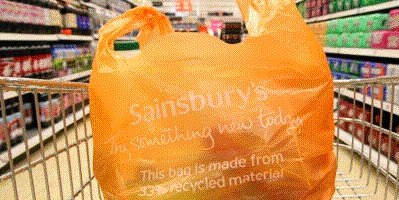
sainsbury bag

sainsbury bag

Today I went to the local supermarket and did the usual rounds of the aisles, loading the trolley with packets of food all wrapped in excessive amounts of cardboard and plastic. Today I picked up less than I usually do, but even so it was more than would fit into one or two bags.

On 1st October, Sainsbury’s took the decision to move the plastic bags off the end of the checkout, but to make them available if asked for. Not realising this, I stopped and asked. The conversation with the enthusiastic (over zealous?) 17yr old lad went along these lines:

“Could I please have some bags?”

“Yes, how many would you like?”

“I think six should do it, thanks.”

“Six? For that little lot? You don’t need six, you could get all of that into just four…”

“Do you think so? I don’t, which is why I have asked for six. If it turns out I can manage with less then I’ll leave some on the end of the checkout. Please pass me six bags.”

Now I wasn’t in a very good mood at that point in the day, and could possibly have been a little less ‘sharp’, but I really do object to being told I can do with less by someone who hasn’t done as much shopping as I have done, who chooses not to question the reason why he has been told to restrict the bags in the first place.

Apparently, it’s to save the planet, some environmental excuse like that. Which is fine – I’m the first to complain if I see something not being done, but I was told that it was the scourge of plastic bags which is most damaging to the environment, and made to feel as I was somehow to blame for the multiple thousands that are strewn along our highways and byways. I was the culprit, obviously.

I pointed out that plastic bags form less than 1% of all landfill, and that plastic packaging, such as that used for ready meals, forms a massive component. What really made me cross was that the supermarkets themselves promoted the use of plastic bags back in the late seventies to replace the humble cardboard box. Does anyone else remember hunting for a decent box under the checkouts and using those to pack the groceries in? When home, the box would be unpacked and crushed to go into the bin… or these days into the recycling. So what happened to boxes then? They were untidy components at the tills, polythene seemed far cheaper, more accessible, maybe. The humble cardboard box was cast out as inefficient and unwanted. Yet what is more environmentally suitable?

To my mind, the supermarkets drive the need for plastic packaging, by demanding foodstuffs that can be kept on the shelves longer, and are responsible for a huge proportion of the environmental damage we have got by importing foods from all over the planet (apparently we consumers demand that they do so) by using less than environmentally friendly processes. They introduce bags that do not degrade, and refuse to absorb far better alternatives, such as alternative plastics because they cost a bit more (and goodness knows, we can’t have a supermarket giant like Sainsbury reducing its profit margin by giving away better bags). They remove the cardboard boxes which were fine, actually, and then employ some spotty 17 year old child who is told to peddle the environmental angle to those of us who can remember what it was like to shop in small greengrocers that have long since been put out of business by supermarkets.

So the supermarket that employs the young man who doesn’t actually question any of what he has been told is the very same one that has been driving the need for the plastic packaging which forms the vast majority of household waste, and then turns on the guilt for the consumer by telling them how wasteful it is to use too many bags… the very bags which make up so very little of the content of land fill sites.

I just don’t get it.

Are we consumers now somehow responsible for the decisions that were taken at corporate level years ago? Decisions that were driven by efficiency demands, cost savings, commercial directions? Are we now going to just sit back and let Sainsbury and Tesco and every other large supermarket hoodwink us all into believing that we are all to blame for this? Maybe we should stop eating lychees and guavas, or tomatoes from Holland, and stick to the foods we can produce in our own country? Actually, I’m quite in favour of that.

Give me back the cardboard box and I’ll take it to a recycling plant. Give me a paper bag to pack the products into.  Start putting milk back in to glass bottles, which are made from a pretty abundant raw material, after all and can be recycled. Start spending some of your enormous profits on envinronmentally friendly, alternative plastics for your bags (if you are going to provide any) and start putting meals for one into packaging that isn’t going to take three barrels of oil to make. But whatever else you do, never ever tell your staff to advise me that I don’t need six bags, particularly when they have no idea about what my needs really are, and when you have spent so much of this planet’s resources lining your pockets with cash for far too long.

Children’s weight problems

General Comments, Scams No Comments »

So the government asked the care trusts to ask the schools to ask their parents if the children could be weighed.

http://news.bbc.co.uk/1/hi/health/7541279.stm

So the children whose parents said ‘Yes’ were weighed, and the data collected and used to inform the nation about the state of obesity in young children. Glory be.

However, a *significant* number of parents said ‘no’ – and I am estimating significant to be around 20% in every county – and so those children were not weighed. Lo and behold, the county closest to home for me declared that there is not an obesity problem with young children for them, and they had the data to prove it. Citing healthy schools initiatives, a growing appreciation of participative sports and all manner of ways that children are being encouraged to exercise and eat a healthy diet, the campaigns have been hailed a success.

I’m sorry if this rains on anyone’s parade, but the 20% of children were very likely the ones who were overtly conscious (and worried, perhaps) about their apparent weight problems. The very children who need to inform the statistics were not included out of their own choice. Suddenly, in a county with some *very* overweight kids (and I have taught a few), none of them have been included in the census.It is hardly surprising that the figures show no obesity, when the obese children were not weighed.

Lies, damned lies and statistics, eh? When will we stop paying out money for this kind of ‘research’ and realise that there are far more realistic ways of gathering the data?

Testing the iphone app for WordPress

General Comments, Mobile Phones, Scams 1 Comment »

So here I am posting directly to my blog using my iPhone. It is slower to type than using a keyboard, of course, but it is at least available to me from anywhere.

And as you can see… I can add an image, too. In this case it is a picture of my recently bashed car – thanks to Robert from Princes Park Manor, N11 who looks left when pulling out of a junction whilst turning right. Twit. Good job it was at walking speed otherwise the damage would be far worse.

Do I still think that mobile phones are good tools for learning? Well yes, actually, and probably more so than before. I am typing at a reasonable speed and am not struggling too much. I have Internet access, can post short texts to a site and basically do most things I would expect to do in a normal lesson if asked to research information or put some text together. Of isn’t yet perfect but it isn’t at all bad.

Bring on more… And soon!!

photo

Dark Mood V2 WordPress theme, editing wordpress files, encoding PHP

PHP coding, Scams, Web Authoring, scripting general 8 Comments »

It may come as no surprise to some to find that freely available themes have got advertising embedded in them by default. It came as a surprise to me, mind you! I downloaded and installed the Dark Mood V2 wordpress theme by Ed Canape and found that in the footer file there was a PHP function that positioned some adverts. Not rocket science, but I wasn’t happy with the kind of ads that appeared. One was a pay per click affiliate program, one about Asian entertainment (ooer…) and one about Philipine paradises. However, what really ticked me off was the fact that the function had been encoded so as to make it hard to unpick it and remove said adverts.

Of all the encoding methods available to PHP programmers, possibly the best is from Zend. One of the most pointless is gencoder (although free). Luckily, it was gencoder that had been used on this occasion. The file looks like this:

encoded php

Now, as you can see there is no easy way to get into the code and remove the advertising links. However, there are two possibilities.

Firstly, you can create a CSS rule in your stylesheet which sets the footer ‘a’ display to be none:

footer a {
display:none;
}

All this does is remove any clickable links in the footer, but leaves the remaining text. This is at best a workaround, but can get you out of a fix if you are in a hurry.

The second thing to do is decode the file! Again, there are two ways to achieve this, but probably the simplest is to edit the ‘eval’ statement to read ‘print_r’ instead. If you then run the code in your browser you’ll see that it makes a bit of a mess visually, but you can still right click and ‘view source’. What you are looking for is at the bottom of the page:

if((isset($v) AND $v==0) OR (isset($t) AND $t==false)){die('This script is protected by <a style"color:cyan\" href="http://www.gencoder.sf.net\"><b><font color"#330099\">G-Encoder</font></b></a>');}echo "<div id"footer\">n";
echo " Powered by n";
echo " <a href="http://wordpress.org\">WordPress</a>n";
echo " and Design by Ivy's <a href="http://www.rubberstampguides.com/\">Rubber Stamp</a> n";
echo " Guiden";
echo " <p><a href="http://www.kirrhi.com/\">Pay Per Click Affiliate Program</a> | <a href="http://yeinjee.com/asianpop/tag/asian-entertainment/\">Asia Entertainment</a> | <a href="http://www.paradise-philippines.biz/\">Paradise Philippines</a></div>n";
echo "</div>n";
echo "n";
echo " <?php wp_footer(); ?>n";
echo "n";
echo "</body>n";
echo "</html>n";

Now you can see the code more clearly, and you can easily see what needs to happen. The last four lines are all you need… in fact, one of those can be deleted! What you really need is the call to the wordpress footer routines and to close the body tag and close the html. This is all that is necessary to complete the footer file in wordpress. Armed with this knowledge, go back and change the ‘print_r’ statement if you like, but better yet, just delete all of that guff. In it’s place simply add the following few lines of code. You can leave out the ‘div’ tags if they are not needed:

<div class="footer">
<?php wp_footer(); ?>
</div>
</body>
</html>

and that’s it. Save the file and you have got yourself an advert free footer space on your wordpress blog.

Thanks (as ever) to Alex Blanc for his timely and ultimately very simple solution to the problem, and no thanks whatsoever to the person who decided to a) put adverts in the footer, and b) encode them at all. I believe each person needs to have the right to choose whether to display adverts, and in this case I chose most strongly not to!

WP Theme & Icons by N.Design Studio
Entries RSS Comments RSS Log in